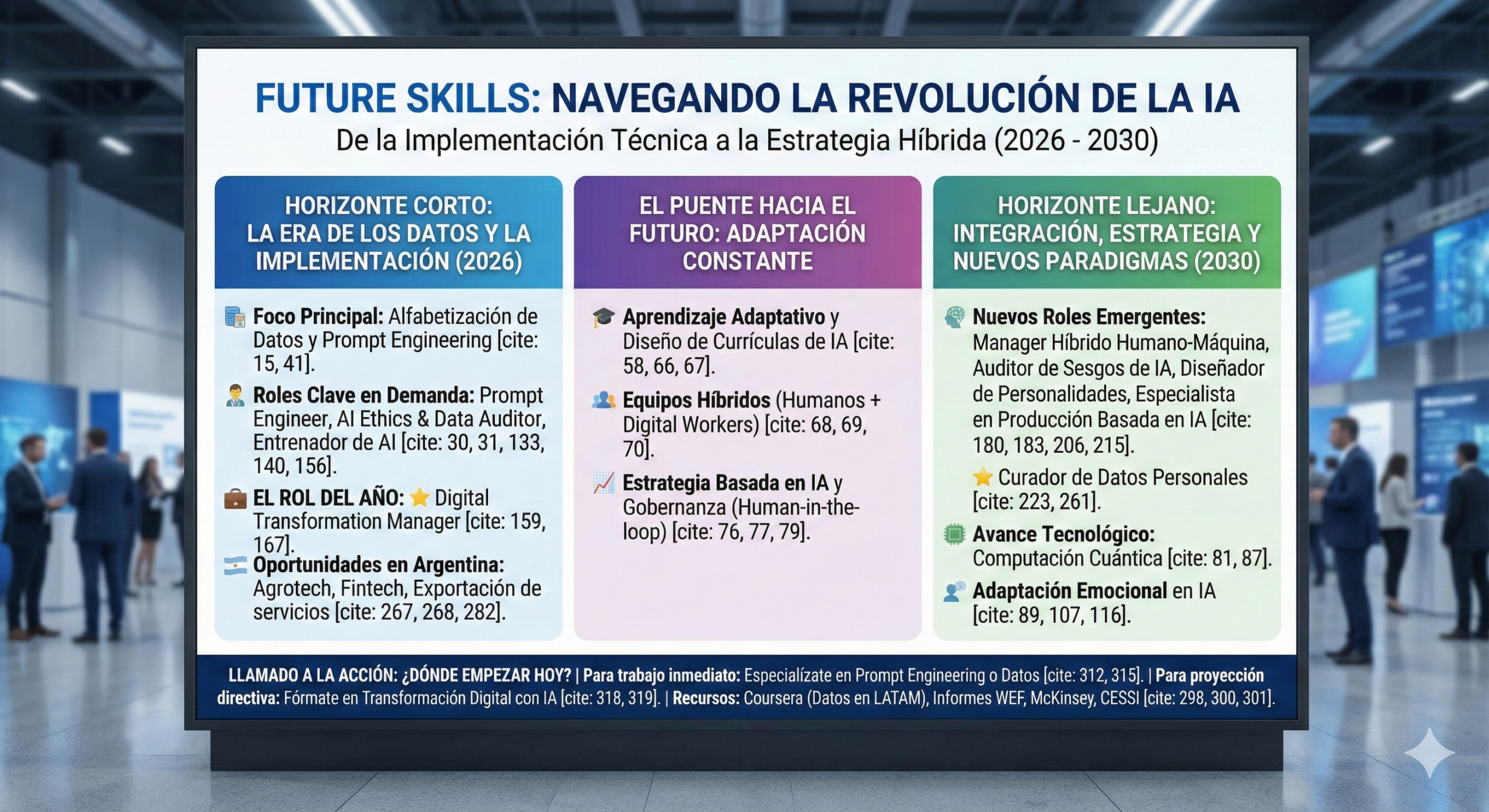
Fundación Conecta presenta su whitepaper sobre el estado de #IA en 2025.
Si están buscando dirección, salir de la PoCitis que aqueja a la gran mayoría de empresas y vislumbrar algo a través de las nubes de humo, permítan este breve aporte.
Hoy di otra charla en Fundación Conecta, corta pero intensa. Y, si soy sincero, cada vez que hablo de futuro tengo la misma sensación: el piso se mueve bajo nuestros pies. La velocidad del cambio ya no es un fenómeno teórico: es la realidad diaria de todas las industrias.
Para ponerlo en perspectiva: me fui de IBM en abril. Hoy, apenas unos meses después, queda una sola persona de todo mi equipo original. No es un caso aislado: el mercado privado entero está reacomodándose para entender qué viene, porque los modelos que funcionaban hace diez años están muertos.
Y ahí entra lo que yo llamo Future Skills: las habilidades que van a definir quién puede navegar esta ola… y quién va a quedar afuera.
2026: El año de la implementación técnica y el dato como petróleo
Muchos están leyendo sobre IA, pero pocos están resolviendo la pregunta realmente importante:
¿Cómo la implemento en mi contexto y cómo genero valor real?
Para eso surgen dos grandes familias de roles:
1. Los roles técnico–funcionales (los híbridos que más empresas necesitan)
En 2026 no se va a premiar al que “sabe programar”, sino al que puede conectar la tecnología con un caso de negocio concreto.
Los dos pilares:
a) Prompt Engineering profesional
No es pedirle cosas al modelo. Es definir roles, límites, fuentes, estilo, datos, formato y validaciones. Un buen prompt permite predecir la salida, reducir errores y escalar procesos.
Hoy, las empresas pagan esto muy bien. Sí: muy bien.
b) Entrenamiento y manejo de datos
La IA solo es tan buena como sus datos. Por eso la demanda más explosiva del 2026 será:
alfabetización de datos
data governance
data privacy
data pipelines
analista de datos
data auditor (o data detective)
Cualquier persona —sin importar su carrera previa— puede formarse en 3 a 6 meses y entrar al mercado.
2. El camino de negocio: análisis, casos de uso y eficiencia
No todo es código. Muchísimas personas podrán reconvertirse desde:
derecho
economía
sociología
administración
educación
…hacia roles que combinen IA + análisis + operaciones.
El rol estrella para 2026: Digital Transformation con IA
Lo digo siempre y lo repito acá: este es el trabajo mejor pago y con más proyección real del país.
¿Qué hace este rol?
Releva procesos completos.
Lleva todo de “papel” a “dato”.
Conecta sistemas legacy con soluciones de IA.
Diseña casos de uso de punta a punta.
Acompaña el cambio cultural.
Quien domine esto en 2026, entra directo a la conversación C-Level.
2030: Donde realmente se juega la futurología
Hacer predicciones a 2030 es arriesgado… pero no imposible. La tendencia ya apunta a varios nuevos horizontes:
1. Managers híbridos humano–máquina
En 2030 ningún equipo será 100% humano. Los líderes deberán manejar:
humanos
agentes autónomos
digital workers
sistemas que se supervisan entre sí
Este perfil no existe aún en Argentina, pero va a explotar.
2. Detectores de sesgos profundos en IA
Ejemplo real: un modelo que aprendió que “si hay una regla en la foto, es cáncer de piel”. ¿Por qué? Porque las imágenes de melanomas suelen tener una regla.
Así funcionan los sesgos.
El profesional que entienda:
cómo detectarlos
cómo mediar riesgos
cómo corregirlos
…va a ser indispensable.
3. Diseñadores de personalidades de IA
Grok ya permite elegir personalidades que filtran todas las respuestas del modelo. Esto abre un nuevo campo:
arquetipos de clientes
personalidades de onboarding
testeos de producto
simulaciones de públicos
interfaces conversacionales con “carácter”
Un área inmensa para marketing, UX y producto.
4. Orquestadores de robótica y automatización física
El puente entre:
IA generativa
impresión 3D
robótica
automatización industrial
Será un nuevo rol: Chief Robotics Officer y sus equipos.
5. Curadores de identidad digital personal
La vida digital ya no es un accesorio: es un activo. Y las IA nos van a interpretar según lo que encuentren sobre nosotros.
De ahí surge un rol que nadie está viendo pero será inevitable:
Gestores de narrativa digital personal.
Profesionales que alineen:
qué mostramos
qué ocultamos
qué debemos corregir
qué impacto tiene en reputación y carrera
Y sí: será un servicio masivo y muy bien pago.
La ventaja competitiva de Argentina
Argentina tiene tres fortalezas estructurales:
capacidad de adaptación a cambios regulatorios constantes
base sólida en ciencias sociales
talento con mentalidad analítica e híbrida
Pero también tiene su talón de Aquiles:
el talento senior se está yendo y es difícil retenerlo.
Esto hace que 2026–2030 sean años críticos para formar una nueva generación, y también una enorme oportunidad para quienes quieran reconvertirse.
¿Por dónde empezar hoy?
Depende del perfil, pero mi consejo es simple:
Si querés empezar YA (menos de 6 meses):
Prompt Engineering
Data Literacy
Si querés una carrera de mayor proyección:
Digital Transformation + IA
Si ya sos manager o director:
Liderazgo híbrido humano–máquina
Estrategia organizacional basada en IA
Si querés apostar al 2030:
Sesgos
Personalidades de IA
Agrotech + biotecnología
Curaduría digital personal
Robótica + automatización local
Cierro con esto
El 2030 parece lejos, pero no lo está. Y la diferencia entre llegar o no llegar a tiempo es simple:
empezar hoy, aunque sea pequeño.
No importa tu edad, tu carrera, tu historia profesional. La IA no reemplaza personas. Reemplaza tareas. Las personas que integran IA, que la entienden y la guían… esas son las que van a liderar el futuro.
Nosotros, desde Fundación Conecta, vamos a seguir formando a quienes quieran estar en ese lugar.
El futuro está cambiando rápido. Pero todavía —todavía— estamos a tiempo de decidir cómo queremos surfear esta ola.
Hoy en Fundación Conecta tuvimos la tercera sesión del programa de Inteligencia Artificial, y fue probablemente la más importante: entender cómo preparar un proceso antes de aplicar IA, y por qué la tecnología es lo último en este camino.
💡 La clave: antes de automatizar, hay que entender el problema, mapearlo y generar consenso. Sin eso, la IA solo acelera ineficiencia.
🔍 1. El problema no es técnico: es humano y es de procesos
Muchas organizaciones piden “una solución de IA” para un problema… que ni siquiera está bien definido. La formulación del problema es más importante que la solución.
Ejemplo clásico: “Queremos que los boletines escolares salgan más rápido.” Pero el problema real no era la velocidad: era la cantidad de pasos inútiles del proceso actual.
📌 2. Value Stream Mapping: el corazón de la transformación
En la sesión trabajamos con un ejemplo simple: la producción de un suéter en Indigo del Sur.
Mapeamos, paso a paso:
La granja y el esquilado
Clasificación
Corte
Costura
Stock
Publicación y venta
➡️ El ciclo total era de 56 días. Cuando analizamos dependencias, tareas improvisadas, tiempos de espera, comunicaciones informales… descubrimos que solo una parte pequeña es trabajo real. Todo lo demás es fricción.
Aplicando automatizaciones simples con IA + Make.com, un proceso real de cliente bajó de 26 días a 8 días.
🤖 3. IA no reemplaza a nadie: ordena, asigna y libera tiempo
Muchas tareas que hoy consumen horas pueden ser automatizadas:
Asignación automática de tareas
Gestión de ausencias desde WhatsApp
Tickets de soporte generados por voz
Ordenamiento y planificación del taller
Control de dependencias y cuellos de botella
La IA no corta ni cose: 🔸 Lo que hace es quitarle al equipo lo repetitivo, para que puedan enfocarse en lo realmente productivo.
📉 4. Cuando se ordena el proceso, llega el impacto
Con un buen Value Stream Map, los resultados que medimos en proyectos reales incluyen:
🚀 Ciclos productivos más cortos
📦 Menos inventario parado
📈 Más conversiones y menos carritos abandonados
😊 Mejora en la satisfacción del cliente
💰 Reducciones de costo de USD 1.500 mensuales por proceso
🌱 5. Y lo más importante: construir consenso
La IA no se implementa en una computadora, sino en la cabeza de las personas.
Para que funcione, se necesitan tres consensos internos:
Qué problema vamos a resolver
Cómo vamos a medir si funciona
Cómo vamos a pasar del estado actual a uno deseado
Sin esto, cualquier automatización es humo.
🔮 Bonus polémico
Cierro con una idea incómoda que surgió en la charla: Muchos “visionarios” venden sueños tecnológicos imposibles… para vender otra cosa.
En IA pasa lo mismo: 📢 Mucha ilusión, poca estrategia. Si no entendemos el proceso, la herramienta no sirve.
📅 Próxima sesión
La semana que viene vamos a ver: “Qué habilidades necesita una persona para trabajar en 2025 y 2030 en el mundo de IA.”
Spoiler: hoy ya hay una explosión de búsquedas de Prompt Crafters y Change Managers… y no hay suficiente gente preparada.
Si quieren el tablero de Miró o el esquema de automatización en Make.com, me lo piden por mensaje.
IA en Empresas: Más Allá de la Automatización Superficial
Hoy hablamos sobre el último informe de McKinsey que revela que, aunque el 88% de las grandes empresas usa IA, solo un tercio logra implementarla efectivamente. Exploramos por qué la IA no es una solución mágica, sino un acelerador que requiere comprender profundamente los flujos de valor de cada industria.
For years, I’ve dedicated my research and teaching to mindfulness—from academic work at Sigeva, Cari, Rieb and Universidad del Salvador, to corporate mindfulness programs at IBM, to community workshops in schools, hospitals, and prisons.
One thing became clear to me: mindfulness needs to be both accessible and scientifically rigorous. Too often, it is presented either as mystical or overly simplified, missing the depth and evidence that support its transformative power.
That’s why I wrote Scientific Mindfulness.
This book is a four-week, evidence-based program that integrates breathing, body awareness, mindful eating, and mindful walking. Each practice is explained clearly and supported by peer-reviewed studies, systematic reviews, and decades of clinical research.
What sets this book apart:
🔹 Trauma-sensitive guidance – acknowledging that practices can surface difficult emotions, with options to adapt or pause.
🔹 Medical & psychological cautions – encouraging responsible and safe practice.
🔹 Inclusivity – adapting mindfulness for diverse bodies, backgrounds, and neurodiverse experiences.
🔹 Context for quotes & references – so readers know why voices like Thich Nhat Hanh or Jon Kabat-Zinn matter.
🔹 Normalizing challenges – because mindfulness isn’t always easy, and that’s okay.
My hope is that this book empowers readers to practice in a way that is not only effective but also safe, inclusive, and sustainable.
Yo voy a hacer una predicción, con el más terrible de los oráculos: los procesos históricos.
Mi predicción es: hay algo que se esfuerza en nacer, en múltiples países. Hasta ahora viene siendo abortado, muchas veces de forma violenta. Pero sigue intentando.
Es algo que surge de los diferentes movimientos antipolítica y busca, de alguna manera, ser una nueva forma de política. Pero este movimiento es
“Un Estado multiétnico, multilingüe, multicultural, inclusivo y federal.” — Preámbulo de la Constitución de Nepal (2015)
El camino de Nepal hacia un sistema representativo moderno es uno de los más turbulentos y fascinantes de Asia.
Podemos resumirlo de la siguiente manera:
Acto 1: El pueblo Nepal se organiza en una sociedad democrática
Acto 2: Alguien de la oligarquía (generalmente, con apoyo externo) viene y les dice “No, esto de la democracia no es para ustedes, vamos a un gobierno autoritario”
Acto 3: El pueblo Nepalí se rebela y vuelve al acto 1
Desde la oligarquía Rana (1846–1951), pasando por el breve experimento democrático de 1959, la monarquía autoritaria del Panchayat (1960–1990) y las dos grandes revoluciones populares (1990 y 2006), el país ha buscado una y otra vez responder a la pregunta: ¿cómo incluir a todos en un Estado tan diverso y afianzar la democracia en una sociedad tan sacudida por el autoritarismo?
Veámoslo en acción
Acto 1
En 1951, tras la caída de los Rana, Nepal ensayó por primera vez el multipartidismo. B.P. Koirala fue elegido en 1959 como primer ministro en elecciones libres, peeeero
Acto 2
apenas un año después el rey Mahendra disolvió el parlamento y estableció el sistema Panchayat, un régimen “sin partidos” que concentraba el poder en el trono.
El Rey Mahendra. Fuente: Wikicommons
Durante treinta años, la representación política fue mínima. El rey se presentaba como garante de la “unidad nacional” frente a India y China, pero en la práctica anulaba cualquier pluralismo.
Acto 3
En 1990, la Jana Andolan I (Movimiento Popular) derribó el Panchayat y restauró el multipartidismo bajo monarquía constitucional. Sin embargo, la inestabilidad, la corrupción y la exclusión persistieron.
De este caldo de cultivo surgió la insurgencia maoísta (1996–2006), que denunció la marginación de campesinos, minorías étnicas y mujeres. El conflicto armado dejó más de 13.000 muertos, pero también abrió paso a una nueva transformación: el acuerdo de paz de 2006, la abolición de la monarquía en 2008 y el inicio de la república federal.
Las Protestas del 2006. Fuente: Wikicommons
Vamos de nuevo al Acto 1
Tras años de asamblea constituyente y fuertes disputas (particularmente con la comunidad madhesí en el sur), en 2015 se promulgó la Constitución de Nepal. Sus pilares representativos son:
Federalismo: 7 provincias con gobiernos y asambleas propias, además de 753 municipios y consejos rurales.
Cuotas de inclusión: en las listas proporcionales los partidos deben garantizar la participación de:
Mujeres (mínimo 33%).
Dalits (castas históricamente discriminadas).
Adivasi janajatis (pueblos indígenas).
Madhesíes, tharus, musulmanes y comunidades de regiones atrasadas.
Comisiones de inclusión: instituciones autónomas para velar por los derechos de mujeres, dalits, indígenas, madhesíes y otros grupos.
Como escribió el constitucionalista Krishna Hachhethu:
“La Constitución de 2015 es más que una carta política: es un pacto social que reconoce la diversidad como fundamento del Estado.”
Peeero, Acto 2
Khadga Prasad Sharma Oli (conocido como K.P. Oli) fue la figura política dominante del período republicano. Líder del CPN-UML, ejerció como primer ministro en tres mandatos anteriores (2006, 2015–16, 2018–21) y nuevamente desde julio de 2024 en su cuarto mandato.
Su estilo se caracterizó por:
Nacionalismo: retórica fuerte frente a India, acercamiento estratégico a China (incluido un acuerdo de tránsito en 2019 para reducir la dependencia india).
Centralización del poder: tendencia a gobernar por decreto, debilitando instituciones colegiadas.
Autoritarismo legal: en 2020 y 2021 intentó disolver la Asamblea de Representantes, argumentando bloqueos parlamentarios. La Corte Suprema anuló ambas disoluciones por inconstitucionales, marcando un duro enfrentamiento entre el poder judicial y el ejecutivo.
Sharma Oli. Fuente: Wikicommons
Estas disputas minaron su legitimidad y consolidaron su imagen de “hombre fuerte” pero poco comprometido con el espíritu inclusivo de la Constitución.
Y ahora, nuestro Acto 3 actual
En septiembre de 2025, el gobierno de Oli ordenó la prohibición de 26 plataformas de redes sociales (Facebook, WhatsApp, Instagram, TikTok, YouTube, Reddit, etc.), alegando que no habían cumplido con el registro local exigido por la nueva Ley de Medios Sociales y que propagaban “desinformación”.
La medida fue vista como un intento de censura contra la generación más conectada digitalmente. La reacción fue inmediata:
Nació el lema #NepoKid, denunciando el nepotismo de los partidos, incluidos los “marxistas dinásticos”.
Las protestas juveniles se multiplicaron en Katmandú y otras ciudades, lideradas por activistas como Sudan Gurung (Hami Nepal).
La represión policial dejó 19 muertos y cientos de heridos.
Pese a levantar el bloqueo días después, el país ya estaba en llamas: residencias de líderes políticos fueron incendiadas y ministros renunciaron en masa. Finalmente, el 9 de septiembre de 2025, Oli dimitió afirmando que lo hacía “para allanar el camino de una resolución constitucional”.
Protesta en Nepal. Fuente: Aljazeera
Entonces ¿qué podemos observar del recorrido que hicimos?
Varias cosas:
La historia constitucional de Nepal es la de un péndulo entre exclusión y apertura. Si el Panchayat impuso un “silencio democrático” durante tres décadas, la Constitución de 2015 buscó lo contrario: un coro plural de voces.
Sin embargo, la experiencia de Oli demuestra que las reglas no garantizan la práctica: intentos de disolver el parlamento, concentración de poder y censura digital reavivaron el fantasma del autoritarismo.
Las protestas Gen Z y el grito #NepoKid marcan una nueva etapa: la exigencia de una democracia no sólo inclusiva en los papeles, sino ética, meritocrática y genuinamente representativa.
En el momento que escribo estas líneas, todo está en suspenso. Quizás figuras carismáticas como Sudan Gurun (sudangrg_haminepal en Instagram) pueda canalizar los reclamos y finalmente, establecer un sistema político más estable. Quizás se vuelva al Acto 1, una vez más.
Pero hay nuevos elementos, la lógica de las redes, símbolos que antes no aparecían.
La Bandera de Luffy como símbolo. Fuente: Mathurbhumi
La presión del reclamo, de lo nuevo que aún no es, se incrementa. Los ministros corriendo desnudos, escapando del pueblo que les reclama lo que prometieron y no cumplieron.
Hi, I’m Dr. Federico “Fede” Andino—researcher, Buddhist teacher (Lama Fede), and mindfulness practitioner with over 20 years of experience. I’ve spent my career studying meditation (BA, MSc, PhD, and postdoc work on Tibetan practices), teaching it globally—at schools, prisons, hospitals, and corporations like IBM, where I’m a researcher on Mindfulness—and building communities around it. I’ve written books, led studies, and even chaired the Tibetan Religion class at Universidad del Salvador for 15 years.
Now, I’m pouring all that into a new 4-week, science-based mindfulness course to help you sharpen focus, reduce stress, and thrive through practical techniques and community support.
Here’s the deal: I’m opening 10 free spots for my first group, starting soon. In return, I’d love for you to try it out and share a short, honest report on what worked, what didn’t, and how I can make it even better. That’s it—no strings attached. My goal? To refine this into something truly impactful, with your input.
If you’re curious about mindfulness, want to boost your well-being, or just love a good experiment, just sign up here: https://federico-andino-s-school.teachable.com/p/scientific-mindfulness-meditation-for-the-masses
First 10 get in, free. Let’s build something great together!
Since I’ve been pumping out articles, one of the most common questions that I’ve been getting is: hey, what exactly is what a Digital Transformation consultant does?
This probably is too complex a question for me to answer, but I’m going to take a stab at it, anyway.
The thing is, I’ve been a consultant most of my professional adult life.
I don’t mean to brag about it. It just means that I’m old, to be honest. But in the 27 years (to date) that I’ve been working in corporations, I’ve alternated being a lead of different things such as Architecture , Agile Transformations, Industrial Transformation, etc. i.e. gaining experience in an Area and then doing Consultancy on it.
So, from all the job roles that I’ve done, “Consultant” is the more constant label.
I’m still learning; I’ve had some incredible mentors (which are key to learn something on the job) and I’m lucky to be working right now with some of the best consultants that I know.
So, bearing in mind all these caveats, this is:
FECHO’S FIELD GUIDE TO DIGITAL CONSULTANCY
Table of Contents:
Introduction
Understanding Digital Transformations
Management Consultancy: A Key Player in the Process
Enterprise Agility: Accelerating the Transformation
The Role of the Consultant in Digital Transformations
Key Responsibilities and Deliverables
Essential Skills for Success
Conclusion
Introduction
As the world continues to embrace digitalization, organizations need to adapt their business models to remain competitive and innovative. This adaptation requires a comprehensive understanding of digital transformations, incorporating both management consultancy and enterprise agility. Fecho’s Field Guide aims to provide a detailed overview of the work involved in digital transformations consultancy with a focus on management consultancy and enterprise agility.
Understanding Digital Transformations
Digital transformations involve the integration of digital technologies into all aspects of a business, changing the way it operates and delivers value to its customers. It requires organizations to rethink their entire business model and processes, enabling them to become more agile, innovative, and customer-centric.
Key components of a digital transformation include:
Business Model Innovation
Customer Experience Enhancement
Operational Efficiency Improvement
Workforce Empowerment
Digitization of Products and Services
Data-Driven Decision-Making
Management Consultancy: A Key Player in the Process
Management consultants play a crucial role in driving digital transformations by providing expert guidance and support throughout the process. They help organizations to:
Assess their current digital maturity and identify gaps
Develop a comprehensive digital transformation strategy
Implement the transformation plan, including change management initiatives
Monitor and measure the impact of the transformation efforts
Continuously refine the transformation strategy to ensure long-term success
Enterprise Agility: Accelerating the Transformation
Enterprise Agility is the ability of an organization to adapt quickly to changes in the market and maintain a competitive advantage. It is a crucial component of successful digital transformations, as it enables organizations to respond effectively to evolving customer needs, emerging technologies, and new business models. Enterprise agility involves:
Adopting Agile methodologies and practices
Implementing Lean principles to streamline operations
Developing a culture of continuous improvement and learning
Fostering cross-functional collaboration and communication
Leveraging data and analytics for informed decision-making
The Role of the Consultant in Digital Transformations
As a consultant in digital transformations, your work (and mine) entails providing expert guidance and support to clients throughout their digital journey. This involves:
Analyzing the client’s current state and digital maturity
Identifying opportunities for improvement and growth
Developing a tailored digital transformation strategy
Facilitating the implementation of the transformation plan
Ensuring the alignment of the organization’s strategy, culture, and processes
Monitoring and measuring the impact of the transformation efforts
Providing ongoing support and guidance to ensure long-term success
Key Responsibilities and Deliverables
As a digital transformation consultant, your key responsibilities and deliverables include:
Conducting digital maturity assessments
Developing comprehensive digital transformation roadmaps
Assisting with implementing digital technologies and solutions
Facilitating change management initiatives
Providing training and coaching on Agile methodologies and Lean principles
Ensuring alignment between business strategy, technology, and operations
Measuring and reporting on the impact of digital transformation efforts
Identifying and mitigating risks associated with the transformation process
Essential Skills for Success
To be successful in your role as a digital transformation consultant, you need to possess a combination of technical and interpersonal skills, including:
Strong analytical and problem-solving abilities
Deep understanding of digital technologies and trends
Familiarity with Agile methodologies and Lean principles
Excellent project management and organizational skills
Effective communication and presentation abilities
Strong interpersonal and relationship-building skills
Ability to adapt to and manage change effectively
Sound understanding of various industries and business models
Experience in implementing and managing digital initiatives
Conclusion
In conclusion, as a consultant in digital transformations with a focus on management consultancy and enterprise agility, your work entails guiding organizations through their digital journey by providing expert insights, developing tailored strategies, and facilitating the implementation of digital initiatives. You play a crucial role in helping businesses adapt to the rapidly changing digital landscape, ensuring they maintain a competitive edge while embracing innovation and customer-centricity.
By leveraging your skills and expertise in digital technologies, Agile methodologies, and Lean principles, you support organizations in achieving their digital transformation goals, ensuring they remain relevant and successful in today’s increasingly digital world.
So, we’ve discussed SAFe enough, yes? Probably more than what you wanted, to be honest. I love SAFe, I do, but sometimes it seems it is the only Enterprise Agility framework that exists. But that’s not the case. There’s LeSS, for example.
LeSS, or Large Scale Scrum, is an agile framework specifically designed to streamline the process of scaling Scrum across multiple teams working on a single product. As organizations grow and undertake more complex projects, it becomes increasingly important to ensure that teams collaborate effectively and deliver high-quality products within budget and time constraints. LeSS provides the necessary tools and techniques to achieve these goals by emphasizing lean thinking, systems thinking, and empiricism.
Where does it comes from?
LeSS was created by Craig Larman and Bas Vodde, two experienced Scrum practitioners who sought to address the challenges of scaling Scrum without compromising its core principles. Drawing on their extensive experience coaching organizations in agile practices, Larman and Vodde developed the LeSS framework as a response to the growing need for a scalable Scrum solution that maintains the simplicity and agility of the original methodology. Their main philosophy could be seen as Keep it Simple as much as Possible, but no more. Compare and Contrast to SAFe Wall of Acronyms.
Key Principles of LeSS
Leverage Scrum’s Simplicity
LeSS retains the simplicity of Scrum by focusing on the essential elements that make Scrum an effective framework for product development. It avoids adding unnecessary complexity or bureaucracy, emphasizing that the same Scrum principles and practices apply to teams of all sizes.
Systems Thinking
LeSS emphasizes the importance of systems thinking in understanding how teams, products, and organizations interact. By considering the entire system, rather than individual components or teams in isolation, LeSS helps organizations identify areas for improvement and potential bottlenecks, ensuring smoother collaboration and more effective decision-making.
Empirical Process Control
Empiricism, or learning through experience, is at the core of LeSS. The framework encourages organizations to experiment, inspect, and adapt their processes, enabling them to continuously improve and respond to change effectively. LeSS also emphasizes the importance of transparency, inspection, and adaptation as the three pillars that support empirical process control.
Lean Thinking
LeSS incorporates the principles of lean thinking, which focus on maximizing customer value while minimizing waste. By identifying and eliminating non-value-adding activities, organizations using LeSS can increase their efficiency, reduce costs, and deliver better-quality products faster. Still, it incorporates principles rather than full-on practices like SAFe.
Key Practices of LeSS
One Product, Multiple Teams
LeSS emphasizes that all teams working on a product should be part of a single, unified effort. This approach ensures that teams share a common goal and that their work is coordinated and integrated, reducing the risk of duplicated efforts or misaligned priorities.
Feature Teams
LeSS promotes the use of feature teams, which are cross-functional teams capable of delivering end-to-end product features. This structure encourages collaboration, reduces handoffs, and allows teams to work more autonomously, increasing their ability to adapt to changing requirements.
Coordinated Sprint Planning
In LeSS, multiple teams participate in coordinated sprint planning, aligning their efforts and synchronizing their work. This practice ensures that teams are working towards a common goal and that dependencies are identified and managed effectively.
Shared Product Backlog
A single, shared product backlog is used across all teams working on a product in LeSS. This approach simplifies backlog management, ensures that all teams have a clear understanding of the product’s priorities, and promotes collaboration and coordination.
Ok, Fede, that’s all well and good. But how does it compares with SAFe?
And when should you choose one over the other?
LeSS and SAFe (Scaled Agile Framework) are both popular frameworks designed to help organizations scale their agile practices across multiple teams. While they share some similarities, such as their emphasis on lean and agile principles, they also differ in several key aspects. The following comparison will help illuminate the differences and similarities between these two approaches.
Philosophy and Complexity
LeSS is grounded in the simplicity of Scrum and focuses on retaining its straightforwardness while scaling. It emphasizes minimalism and aims to avoid adding unnecessary complexity, bureaucracy, or layers of management. LeSS strives to maintain the agility and adaptability of Scrum, even as the organization grows.
SAFe, on the other hand, is a more prescriptive and comprehensive framework. It provides a detailed blueprint for scaling agile practices and offers a wide range of roles, artifacts, and processes. While SAFe also seeks to maintain agility, its structure and complexity make it more suitable for larger enterprises with multiple layers of management and a higher degree of organizational complexity.
Implementation
LeSS is easier to implement in organizations that are already using Scrum or are familiar with agile principles. Its lightweight nature and focus on the core concepts of Scrum make it a suitable option for those who want to scale their existing agile practices without introducing a significant amount of new processes or roles.
In contrast, SAFe requires more substantial organizational changes and a higher level of commitment from the entire organization. Implementing SAFe often necessitates restructuring teams, roles, and processes to align with the framework’s structure and principles. This may involve a steeper learning curve, but it can provide more guidance and support for organizations seeking a comprehensive approach to scaling agile practices.
Hierarchy and Decentralization
LeSS promotes decentralization, self-organization, and autonomy within teams. It aims to reduce dependencies and handoffs between teams, encouraging cross-functional feature teams that can work independently to deliver end-to-end product features.
SAFe, while still encouraging autonomy and self-organization, incorporates a more hierarchical structure, with specific roles and responsibilities defined for different levels of the organization. This structure is designed to coordinate efforts across teams, programs, and portfolios, but it may also result in a more top-down approach to decision-making and planning compared to LeSS.
Continuous Improvement
Both LeSS and SAFe emphasize the importance of continuous improvement and learning through regular inspection and adaptation. However, LeSS places a stronger focus on empirical process control and systems thinking, encouraging organizations to experiment, learn, and adapt their processes based on real-world experience.
SAFe also values continuous improvement but places more emphasis on its structured and prescriptive framework for implementing agile practices. This structure can provide more guidance for organizations, but it may also limit experimentation and innovation to some extent.
So you go for LeSS when you have LeSS of an Enterprise structure and more of an Agile Mindset in place. Fintechs, Startups, etc. are great LeSS candidates. But for hierarchical institutions like Banks or Utilities companies, SAFe is often a safer bet. #sorrynotsorry
Conclusion
LeSS provides a powerful and effective solution for organizations looking to scale their Scrum practices while maintaining the agility, simplicity, and effectiveness of the original framework. By focusing on lean thinking, systems thinking, and empiricism, LeSS helps organizations to overcome the challenges of scaling, enabling them to deliver high-quality products more efficiently and effectively.
Last week’s article on Two-speed IT brought a lot of interest. But also one repeated question. Ok, you have an hybrid model between Agile and Core ways of working. How do you keep both in sync?
Well, by having a sync-layer and a new role: the Communication Manager.
In Two-Speed IT, a communication manager is a role responsible for developing and implementing communication plans to ensure effective communication between the core IT team and the agile IT team. The communication manager works to establish communication channels and protocols and ensures that all team members are aware of the communication plan and understand their roles and responsibilities. He or she is the main role of the Sync layer.
The communication manager plays a critical role in ensuring that communication is clear and effective between the core and agile IT teams. They are responsible for establishing communication channels, such as email, instant messaging, or video conferencing, and ensuring that all team members are aware of these channels and how to use them. The communication manager also establishes protocols for communication, such as frequency and format, and ensures that all team members understand these protocols and follow them.
CMs are also responsible for monitoring communication channels to ensure that they are working effectively and that team members are communicating with each other in a timely and efficient manner. They also provide feedback to team members to ensure that communication is effective and efficient, and to identify areas for improvement.
The communication manager is typically a highly skilled professional with experience in communication, project management, and IT. They have excellent communication skills, both written and verbal, and are able to communicate effectively with a variety of stakeholders, including business leaders, IT professionals, and end-users.
Overall, the communication manager plays a critical role in ensuring that communication is clear and effective between the core and agile IT teams in Two-Speed IT. By establishing clear communication channels and protocols, and monitoring communication channels to ensure that they are working effectively, the communication manager helps to ensure that the benefits of the Two-Speed IT approach are realized.
The CM populates a layer with a mixture of Agile roles (Scrum Master, PO, etc.) and traditional roles (PM, PMO, etc.) which is used for synchronicity. By enabling a series of intersecting communications between GANTTs, Epics and holding Quarterly Planning meetings, the CMs in an organization keep the work on path.
But which are the other roles of Two-speed it?
The Agile IT Team: The agile IT team is responsible for developing and implementing new systems and technologies that are more flexible and adaptable to change. To achieve this, they need to work collaboratively with business units and stakeholders to understand their needs and requirements. The agile IT team is responsible for communicating the status of their projects, sharing updates on their progress, and collaborating with the core IT team to ensure that the new systems are integrated with the existing core systems. The main Agile roles are Scrum Master, Product Owner, Team Member and Kanban Coach.
The Core IT Team: The core IT team is responsible for maintaining the stability and reliability of the organization’s foundational IT systems. They need to communicate with business units and end-users to understand their needs and requirements, and provide support to resolve any issues or problems that arise. The core IT team is responsible for communicating the status of their projects, sharing updates on their progress, and collaborating with the agile IT team to ensure that the new systems are integrated with the existing core systems. The main roles are Business Analyst, Programmer, Tester, Project Manager.
Together with the CMs, and roles that vary depending on which flavor of methodology you are using (i.e. Agile Coaches, PMOs, etc.) but which can be slotted into one of the three layers:
Agile IT
Core IT
Sync layer
I hope this helps to clarify this aspect of Two-speed IT!